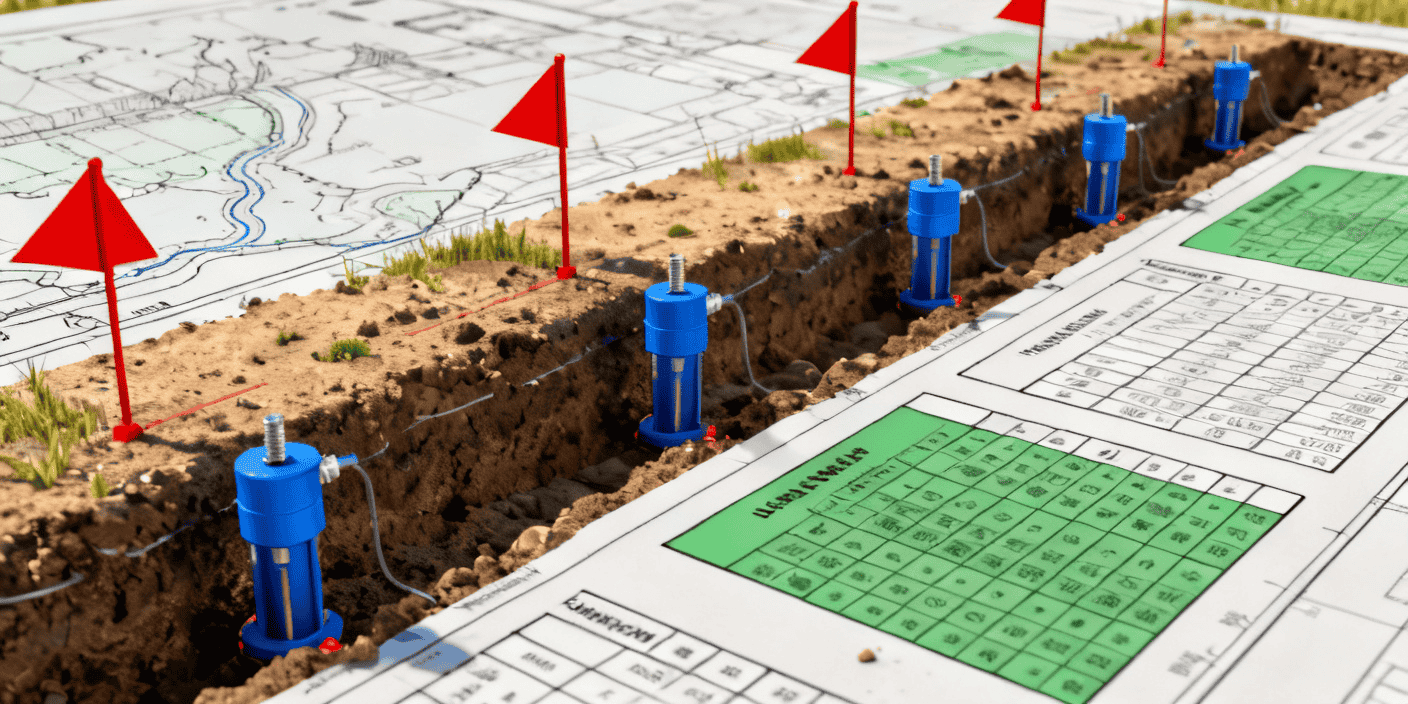
How to Know If There's Water Under Your Land? — A True Story and an Unforgettable Lesson by Eng. Said Alriyami
"How Do I Know If There's Water or Sea Under My Land?"
A young man asked me this question during a casual conversation at a coffee shop — a simple question on the surface, but one that carries within it one of the most important decisions a landowner can make before construction begins.
My answer was direct: you cannot know by looking — but you can know through science.
The True Story — A Project in Sur Al Hadid, Seeb
The Beginning — Land Near the Sea
A client contacted us wanting to build in the Sur Al Hadid area of Seeb Governorate. Once we identified the site location, we decided to conduct a field visit before taking any further step.
During the visit, we noted that the land was approximately 200 meters or slightly more from the sea. We raised our concern with the client immediately:
"We're worried there may be water beneath this land once we excavate."
His response was dismissive: "Seriously? The sea is 200 meters away — it's far!"
The Neighbor's Experience — Reassurance That Wasn't Enough
Adjacent to his plot was a building even closer to the sea than his. We asked the engineer supervising that site: "Did you hit water when you excavated?"
His answer: "We dug and nothing came up — no water at all."
That was reassuring — but a professional engineer does not base decisions on a neighbor's experience. Every plot of land is its own independent story.
The Decision to Test — and a Shocking Result
After discussion, the client agreed to commission a specialized soil investigation from a certified geotechnical company.
The report came back — and the finding was startling:
Water appears at a depth of just 1.2 meters below the surface.
The problem? The required foundation excavation depth was 1.8 meters.
This meant that digging for the foundations would penetrate 60 centimeters directly into the groundwater — changing everything about the structural design.
The Client's Reaction — and a Profound Lesson
The client was genuinely confused: "How is it that my neighbor — who is closer to the sea — has no water, while I do?"
My explanation:
"Groundwater and seawater beneath the earth travel in specific channels and pathways — exactly like oil underground. It does not distribute evenly. It flows through geological formations and layers that vary from one spot to the next. Your neighbor who is closer to the sea may sit on dry ground, while you, further away, sit above a water channel. You simply cannot know this without a proper soil test."
What Did We Do After the Report? — The Redesigned Structural System
After receiving the soil investigation report, we immediately sent it to the structural engineer who conducted a complete foundation redesign suited to the site's actual conditions. The modifications included:
1. Epoxy-Coated / Corrosion-Resistant Rebar
Standard steel was replaced with corrosion-resistant reinforcing bars — because conventional steel rusts rapidly in high-moisture, groundwater-exposed conditions, progressively weakening the structural integrity of the foundation over time.
2. Increased Steel Density and Bar Diameters
Reinforcement density was increased and bar diameters were enlarged to handle the additional structural demands of building in softer, waterlogged soil with lower bearing capacity.
3. Rubber Waterproofing Membrane
A waterproof membrane layer was applied to all foundation surfaces and below-grade walls to prevent groundwater from infiltrating the structural core of the building.
4. Compacted Backfill in 15 cm Layers
Instead of standard backfilling, the soil was compacted mechanically in layers not exceeding 15 centimeters each before the next layer was placed. This guarantees a dense, stable backfill that resists settlement and movement under structural loads.
The Moment That Cannot Be Forgotten — At Excavation
Before excavation began, the client told us: "I want to be on site when they dig."
Despite reading the report, part of him still didn't fully believe it. When the excavation reached the depth specified in the report —
Water appeared.
The client stood there and said, with genuine astonishment: "SubhanAllah."
Why Soil Investigation Is Not a Luxury — It Is an Absolute Necessity
You Cannot See What Is Beneath the Ground
Neither the neighbor's experience, nor the physical appearance of the surface, nor proximity to or distance from the sea — none of these can tell you with certainty what lies beneath your specific plot.
Geological layers underground do not follow uniform patterns — groundwater, weak soil, and rock formations distribute themselves according to natural geological formations that cannot be predicted without scientific testing.
100 Rials Protects a Home Worth 200,000 Rials
A professional soil investigation typically costs between 70 and 100 Omani Rials — against a home that costs 60,000, 150,000, or 300,000 Rials to build.
How can any reasonable person risk their entire lifetime investment to save an amount that represents a fraction of a percent of the total project cost?
The Report Is Ready in Two to Three Days
After the investigation is conducted, the report is typically issued within two to three days. You then take it directly to your structural engineer, who uses it to determine the precise foundation type required. These few days may save you years of problems.
When Should Soil Investigation Be Conducted?
Before beginning structural design — this is the optimal timing. Do not approach a structural engineer without a soil investigation report already in hand, because foundation design depends entirely on soil characteristics.
Land that particularly warrants investigation includes:
- Plots near the sea, rivers, wadis, or water channels
- Areas with a history of flooding or high water tables
- New development zones with no prior construction history
- Any land whose geological history is unknown
But the honest answer? Every plot of land deserves a soil investigation — without exception.
Summary: Never Build on Unknown Ground
| Without Soil Investigation | With Soil Investigation |
|---|---|
| Foundation design may not match reality | Design built on precise scientific data |
| Costly surprises during or after construction | Solutions planned before spending begins |
| Risk of settlement, cracking, and water infiltration | A safe, guaranteed structural foundation |
| Emergency redesign at high unplanned cost | One planned, managed cost from the start |
| Entire investment at risk | Complete protection for a lifetime investment |
"100 Rials for a soil test — or 100,000 Rials in problems with no end. The choice is yours."
About Eng. Said Alriyami
Eng. Said bin Hamad Alriyami is an Omani entrepreneur and construction leader whose career began in the oil and gas fields of the Rub' al Khali desert. In 2004, he founded Afdal International Construction, which has delivered more than 3,000 projects across construction, luxury finishing, and interior design. Eng. Said is committed to sharing real field stories and hard-won expertise to protect project owners from the invisible risks that exist in every construction journey.
Take the First Right Step
Do you own land and want to understand its true nature before design begins? Contact Eng. Said Alriyami for specialist guidance on the correct soil investigation process for your project.
📧 Email: Sriyami1978@gmail.com 📞 Phone: +96897070034
🔗 Follow and connect: Facebook | Twitter / X | Instagram | TikTok | YouTube | LinkedIn | Telegram | Snapchat