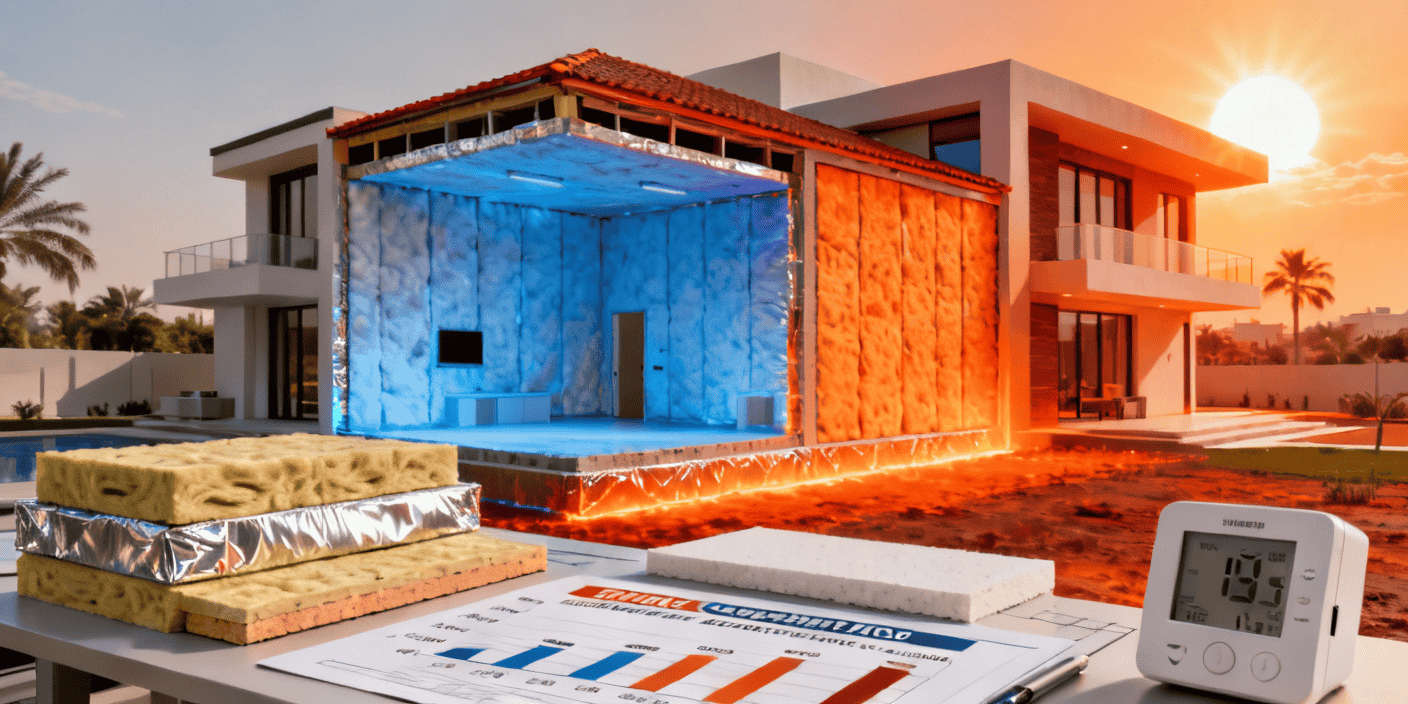
How to Reduce Your Summer Electricity Bill — Thermal Insulation Secrets by Eng. Said Alriyami
Summer Electricity Bills — The Problem and the Real Solution
There's one thing every Gulf household agrees on: electricity bills spike dramatically in summer — and in some months, the increase can be genuinely alarming.
The primary culprit? Air conditioning — which accounts for 60% to 70% of total home electricity consumption during summer months.
But the solution is not to use less air conditioning. The solution is to make your home inherently less dependent on it in the first place. This is precisely what Eng. Said Alriyami explains in this article.
The Core Principle: Stop Heat Before It Enters
Air conditioning cools the air inside your home. But if your home is absorbing heat from every direction — through walls, roofs, and windows — the compressor will run continuously, working to compensate for the heat constantly entering from all sides.
The fundamental solution is to cut off the pathways through which heat enters — and this is exactly what proper thermal insulation achieves.
Factor 1: Insulated Blocks for External Walls
The Critical Distinction: External vs. Internal Walls
This is a detail that many homeowners overlook during construction — and it carries significant consequences:
- External walls (those facing the street and the outdoors) are the first line of defense against heat — and they must be built using thermally insulated blocks (Thermoblock or Insulated Concrete Block).
- Internal partition walls (between rooms) are not exposed to direct sunlight — so standard blocks are entirely sufficient, with no need to incur the additional cost of insulated blocks.
This distinction alone saves a considerable amount during construction, while still achieving the primary goal: preventing external heat from penetrating the home.
How Do Insulated Blocks Work?
Insulated blocks contain a layer of insulating material (such as foam or trapped air) within their core structure, creating a thermal barrier that prevents heat transfer from outside to inside — substantially reducing the thermal load on the air conditioning system.
Factor 2: UPVC Windows With Double Glazing
Standard Windows — A Serious Thermal Weakness
Traditional single-glazed windows are among the largest sources of heat gain and cooling loss in Gulf homes. A thin single pane of glass provides virtually no thermal barrier whatsoever.
UPVC Double-Glazed Windows — The Professional Solution
UPVC (Unplasticized Polyvinyl Chloride) frames combined with double glazing work on the principle of an insulating air gap trapped between two glass panes, delivering:
- Prevention of over 70% of heat transfer through the window opening
- Excellent acoustic insulation that significantly reduces street noise
- Reduced condensation on glass surfaces in humid coastal environments
- Long-term energy savings that more than offset the initial installation cost over time
Factor 3: Polystyrene (EPS) Roof Insulation
The Roof — Your Home's Most Heat-Exposed Surface
The roof of your home receives direct sunlight for the longest duration of any surface, especially during the peak summer hours. Without insulation, it becomes a massive thermal conductor that pumps heat directly downward into upper-floor rooms.
EPS (Expanded Polystyrene / Thermacol) — Effective and Economical
Installing a layer of EPS insulation board on the upper floor roof slab — either above or below the concrete — provides:
- Thermal insulation that prevents over 80% of solar heat from penetrating through the roof
- Very low additional structural weight — it adds almost nothing to the load calculation
- Low material cost relative to the electricity savings it generates year after year
Factor 4: The Bathroom Exhaust Fan — A Small Detail With a Big Impact
A Small Fan... A Much Larger Problem
This is one of the most overlooked points in home energy efficiency — and yet it is one of the most practically impactful observations in this entire article.
Many homeowners leave their bathroom exhaust fans running continuously, reasoning that a 12-volt fan consumes negligible electricity and is therefore harmless.
The truth? The problem has nothing to do with the fan's direct electricity consumption — it lies in its effect on the entire air conditioning system.
How Does the Exhaust Fan Drive Up Your Cooling Costs?
The exhaust fan continuously draws air from inside the home — pulling cooled air from rooms and corridors through gaps and openings (particularly from beneath doors into the bathroom). This creates a negative pressure that draws hot outdoor air in through any available gap in the building envelope to replace what was expelled.
The result? The AC compressor runs non-stop without ever bringing the space to the required temperature, because cooled air is continuously being evacuated through the bathroom and replaced with hot outside air. This translates into significantly higher electricity consumption with no real improvement in indoor comfort.
The Practical Solution:
- Switch off bathroom exhaust fans when not in active use
- Ensure bathroom doors are properly closed during AC operation
- Run the exhaust fan only during actual bathroom use, then switch it off immediately afterward
Summary: How to Reduce Your Electricity Bill by Up to 60%
| Action | Impact on Bill |
|---|---|
| Insulated blocks on external walls | Prevents 60%+ of external heat gain |
| UPVC windows with double glazing | Reduces cooling loss through windows by 70%+ |
| EPS roof insulation | Prevents 80%+ of direct solar heat through roof |
| Switching off bathroom exhaust fans | Stops cold air extraction and relieves compressor |
| Combined cumulative effect | Potential saving of 40–60% on cooling costs |
About Eng. Said Alriyami
Eng. Said bin Hamad Alriyami is an Omani entrepreneur and construction leader whose career began in the demanding environment of the oil and gas fields of the Rub' al Khali desert. In 2004, he founded Afdal International Construction, which has delivered more than 3,000 projects across construction, luxury finishing, and interior design. Eng. Said is dedicated to sharing the practical engineering knowledge that helps Gulf homeowners save money and genuinely improve their quality of life.
Take Action on Your Energy Costs Today
Building a new home and want to incorporate these solutions from the ground up? Or struggling with a high electricity bill and looking for practical remedies? Contact Eng. Said Alriyami for expert engineering guidance.
📧 Email: Sriyami1978@gmail.com 📞 Phone: +96897070034
🔗 Follow and connect: Facebook | Twitter / X | Instagram | TikTok | YouTube | LinkedIn | Telegram | Snapchat